
Are You Still Running the Wrong Covered Hopper?
Wood pellets weigh 40 pounds per cubic foot. That’s a stubborn, unchanging fact, and it’s quietly costing shippers money on every load.

Most pellet shippers already made one smart upgrade: from the standard 4,750 cubic foot covered hopper to the 5,150. Good call. The 5,150 loads around 103 tons of wood pellets at that density. Progress.
The conflict in Iran has sent energy prices upward again. Renewable fuel demand is accelerating on both sides of the Atlantic. European utilities are buying more pellets. Asian markets, too. Southeast U.S. producers and Pacific Northwest mills are being asked to move more volume, faster. And a meaningful chunk of them are doing it with railcars that leave tonnage on the table with every single turn.
There’s a better car. Actually, there are three.
The Math Isn’t Complicated
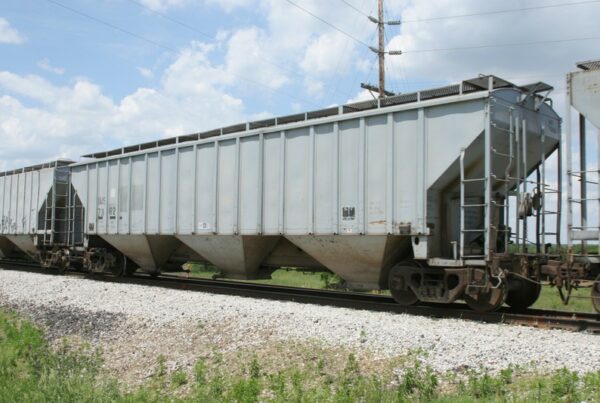
ERS runs a fleet that includes large cube covered hoppers that outperform the 5,150. Here’s what the numbers say, just fleet specs and physics:
| # | Car Type | Cu Ft | Lt. Wt | Load Limit | Tons/Car | Net Cost/Ton | Annual Tons (10 cars, 2 turns) |
| 1 | 5,150 Covered Hopper (baseline) | 5,150 | 62,000 lbs | 224,000 lbs | 103.00 | $38.83 | 24,720 |
| 2 | 6,351 Large Capacity Covered Hopper | 6,351 | 69,300 lbs | 216,700 lbs | 108.35 | $36.92 | 26,004 |
| 3 | 6,541 Large Capacity Covered Hopper | 6,541 | 69,900 lbs | 216,100 lbs | 108.05 | $37.02 | 25,932 |
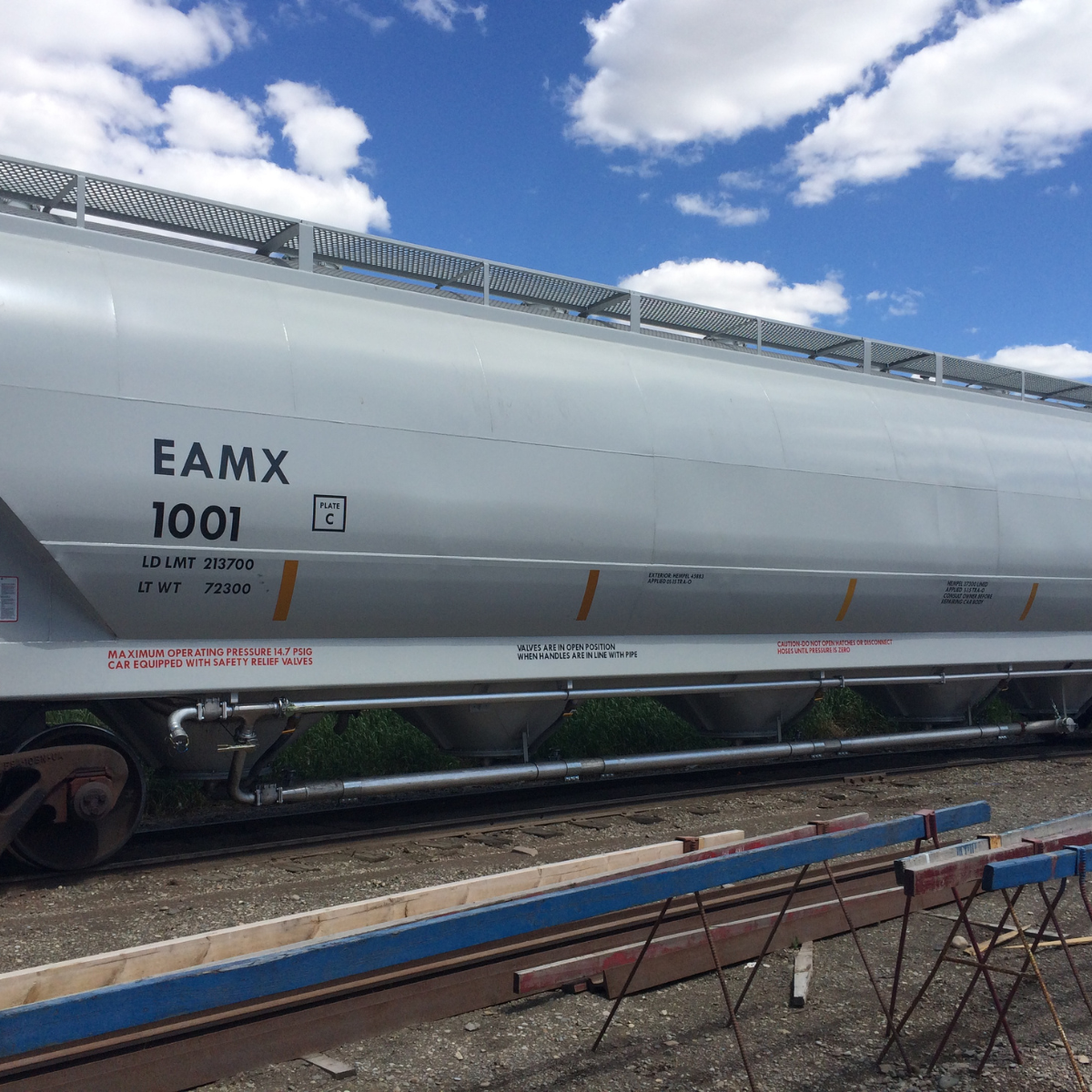
| 4 | 6,011 Aluminum Body Plastic Pellet Hopper | 6,011 | 55,300 lbs | 230,700 lbs | 115.35 | $34.68 | 27,684 |
The 6,351 and 6,541 are easy: bigger cubic capacity, more tons per car, lower cost per ton. About $1.82–$1.92 savings per ton over the 5,150. On a 10-car fleet running two turns a month, that’s 1,200–1,284 additional tons annually.
Good. But not the main story.
The 6,011 Is the Main Story
The 6,011 aluminum body plastic pellet hopper is not the biggest car on this list. The 6,541 has 530 more cubic feet. Doesn’t matter. Because the 6,011 is built from aluminum construction, its tare weight is 55,300 pounds. The steel-body large cube cars run 69,300–69,900 pounds.
That 14,000-pound difference goes straight into load limit.
The 6,011 carries a load limit of 230,700 pounds. The large cube steel cars: 216,100–216,700. On a commodity priced by the carload, more load limit means more tons at the same freight cost.
The 6,011 loads 115.35 tons per car. The 5,150 loads 103. That’s 12.35 more tons per carload, per turn, per lane. Cost per ton drops to $34.68. The 5,150 costs $38.83. That’s $4.16 cheaper, every single time.
Scale that across a 10-car fleet, two turns a month: 27,684 tons annually versus 24,720. Nearly 3,000 extra tons per year from the same fleet, same routes, same crew. For a Gulf export terminal producer on a vessel loading schedule, or a Pacific Northwest shipper with a fixed port window, that’s not a rounding error. That’s the difference between meeting the contract and scrambling.
This car was built for exactly this commodity. It shows in every number.
One Thing Worth Understanding
There’s a column in fleet analysis that shippers sometimes skip: CF @ Weigh Out. It’s the cubic footage of product the car can hold at the moment it hits its weight limit.
For the 5,150, CF @ Weigh Out is 5,600, greater than the car’s actual capacity. The car fills up before it weighs out. It is cube-limited. You physically cannot add another pound of product.
For the 6,011, CF @ Weigh Out is 5,768, below its 6,011 cubic capacity. The car weighs out before it fills up. It is weight-limited. Every pound of additional load limit translates directly into payload.
Pellet density varies across grades, moisture levels, and producers. When it does, a cube-limited car gives up tons immediately. The 6,011 keeps loading to its structural ceiling regardless. That distinction matters in a commodity where “nominal 40 lbs/cu ft” covers a meaningful range of actual product.
The Window
Energy market volatility doesn’t ask for your timeline. Producers with the right fleet already in place capture the demand spike when it comes. The ones running suboptimal cars absorb the inefficiency at exactly the moment margin pressure is highest.
Getting into the right covered hopper before demand peaks is the kind of decision that looks obvious in hindsight and costs nothing to make early.
Run Your Own Numbers
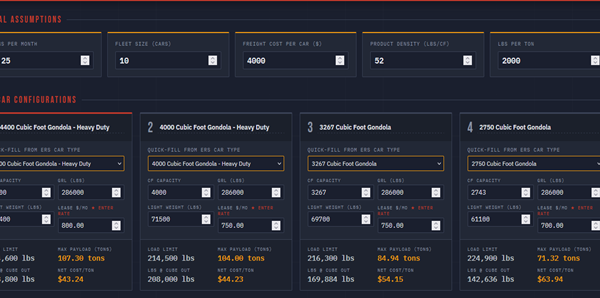
The analysis above uses $4,000 freight per car, 40 lbs/cu ft, 10 cars, and two turns per month. Your operation has different inputs. Use our free Pricing Tool to run the comparison against your actual OD pair, freight rate, and density, preloaded with every car in this analysis.
About the ERS Covered Hopper Fleet
ERS has been leasing railcars since 2001. Our covered hopper fleet includes large cube steel-body cars and the 6,011 aluminum body plastic pellet hopper, available for lease with flexible terms designed for producers who want equipment matched to their commodity, not whatever is available on the lot. We work with small to mid-size shippers across the U.S., including the Southeast and Pacific Northwest markets where wood pellet production is concentrated.