
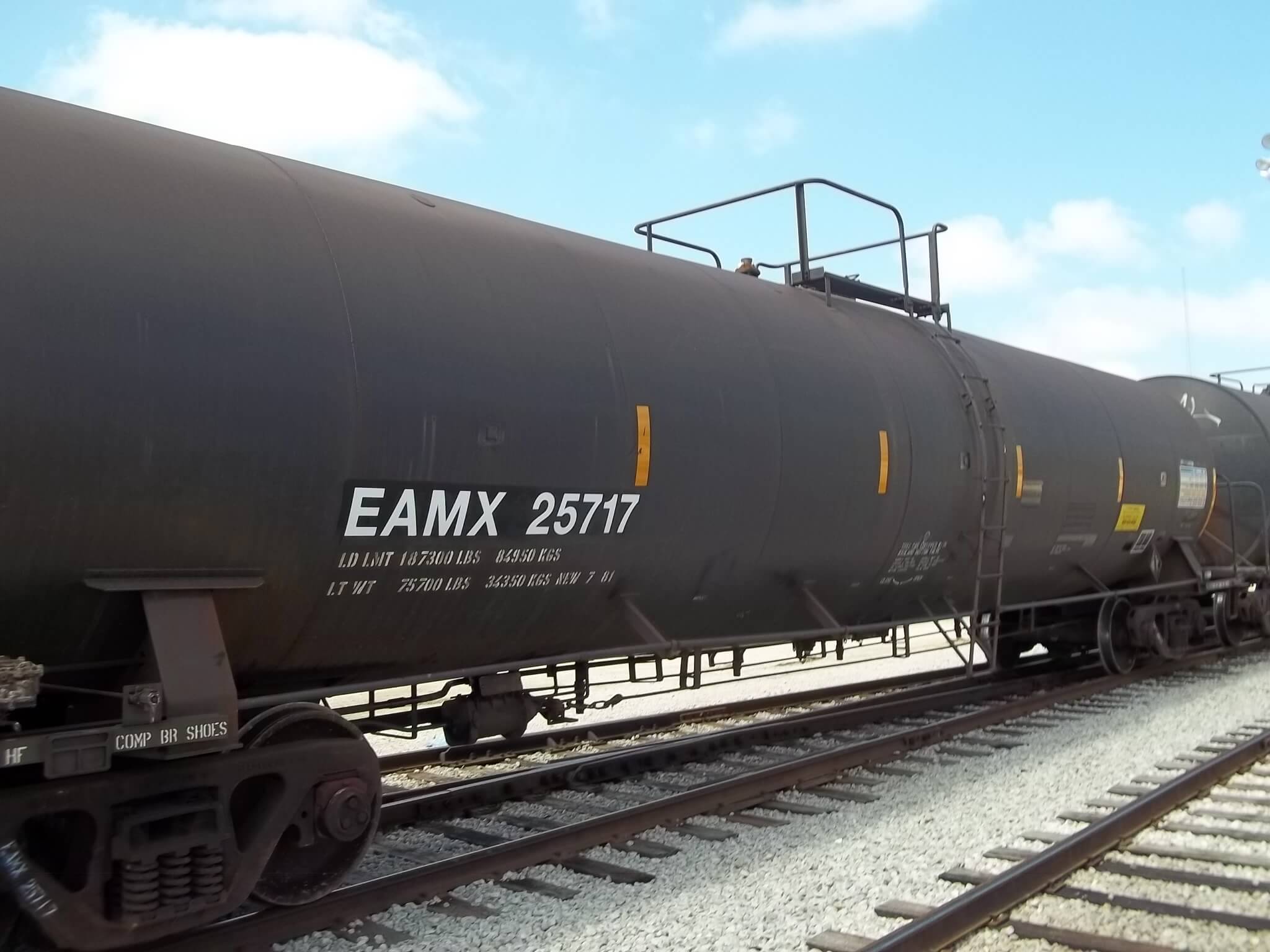
What Tank Cars Transport and How They’re Identified
Our president has seen just about everything in the railcar industry. But it wasn’t until recently, while watching an episode of Breaking Bad, that he recognized both the location and one of our own tank cars.
Here’s the story, in his words.
Better Call ERS: The Tank Car That Starred in Breaking Bad
I have been in the railcar business for a long time. I have seen a lot of cars come and go — covered hoppers, gondolas, flatcars, and more tank cars than I can count. After more than two decades in this industry, I thought I had heard every story there was to tell about a railcar.
Then I started watching Breaking Bad.
A Familiar Location
Season 5, Episode 5. The scene is set on a stretch of railroad in the New Mexico high desert, outside Santa Fe. The moment I saw the landscape, I recognized it immediately. I have spent years working with the Santa Fe Southern Railroad (SFS) and know that territory well.
Then I saw the locomotive, the SFS markings and something clicked.
Then I saw the tank car. That low, wide cylindrical silhouette. The ACF design. The proportions. I paused the screen. I knew that car.
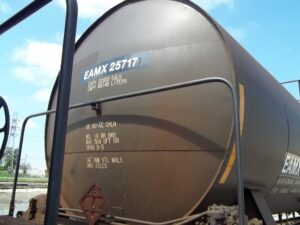
The unmistakable ACF profile 23,553-gallon capacity, DOT 111A100W1 classification.
The Loan I Forgot About
Back in 2012, Everest Railcar Services, Inc. held the rights to use the SFS mark. The Santa Fe Southern ownership reached out and asked if I could loan a few tank cars for a movie production. I said yes. I did not think to ask what the production was.
Thirteen years later, I had my answer.
How I Knew It Was Ours
The production team had done their homework…mostly. They changed the car mark stenciled on the body. Where EAMX 25717 had been, the car now read BS5E 10314. New decals, different reporting mark, different number. But they missed something.
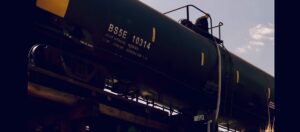
The production changed the car mark on the body to BS5E 10314. Good effort.
On railcars, the reporting mark and number are stenciled in two places: on the body of the car, and on the trucks (the wheeled assemblies underneath). The production team changed the body decals. They did not change the truck stencils.
Right there on screen, underneath the car, in plain white stenciling. EAMX 25717 had made its Hollywood premiere, and it had left a calling card.
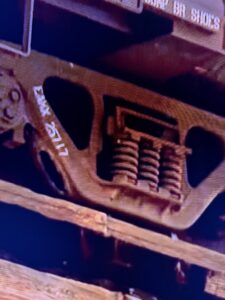
The truck stencils they forgot to change still show our mark EAMX 25717
What Is EAMX 25717 Doing Now?
We can neither confirm nor deny what it was hauling on screen.
What we can confirm is what it is storing today: wax.
From one highly specialized chemical operation to another. Walter White would be disappointed. We are not.
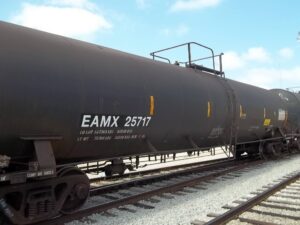
EAMX 25717 today — reliably hauling something considerably less dramatic.
How Tank Cars are Built to Perform
Beyond the Hollywood cameo, EAMX 25717 represents something more important: the versatility and durability of a well-maintained tank car.
Tank cars are the most specialized type of rolling stock in the freight fleet. They’re built to strict DOT and AAR specifications and designed to safely transport liquid and gaseous commodities across thousands of miles of the North American rail network.
To put that into perspective, a single car like EAMX 25717 with a 23,553‑gallon capacity can move the equivalent of roughly 75 standard tanker trucks in a single trip.
What Tank Cars Actually Haul
The range of commodities moved by tank car is broader than most realize:
- Petroleum products — crude oil, diesel, fuel oil, gasoline
- Chemicals — industrial solvents, acids, caustic solutions
- Food-grade liquids — corn syrup, vegetable oil, juice concentrates, molasses
- Liquefied gases — propane, ammonia, chlorine
- Specialty products — waxes, resins, adhesives, latex
Each commodity class requires a specific car design: different pressure ratings, lining materials, valve configurations, and safety systems. Matching the right car to the right product is not guesswork. It requires experience.
The DOT 111A100W1 Classification
EAMX 25717 carries a DOT 111A100W1 classification — one of the most common designations in the non-pressurized tank car fleet. The “111” indicates a general service tank car, “A” denotes a normalized or annealed steel shell, “100” refers to the test pressure in psi, and “W” indicates fusion welding construction. This classification makes the car suitable for a wide range of non-pressurized liquid commodities including, as it turns out, wax.
The ACF Design Legacy
EAMX 25717 was built in July 1981 by ACF Industries (American Car & Foundry) one of the most storied names in North American railcar manufacturing. ACF tank cars built in the late 1970s and early 1980s are known for their structural integrity and longevity. More than 40 years after rolling out of the factory, EAMX 25717 is still in active service. That is not an accident. It is a product of sound engineering and consistent maintenance.
Leasing a Tank Car Through ERS
Everest Railcar Services, Inc. has been connecting shippers with the right equipment since 2001. Whether you need a single tank car for a specialty product or a dedicated fleet, we work with you to match the right car type, capacity, and lease structure to your operation.
Our fleet supports a wide range of liquid commodities. We handle the equipment, and you stay focused on the cargo.
None of our current lessees are, to our knowledge, featured on television. But we remain open to the possibility.
If you’re evaluating tank car types, we’re always available to talk through your requirements.